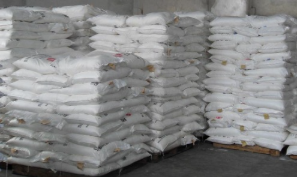
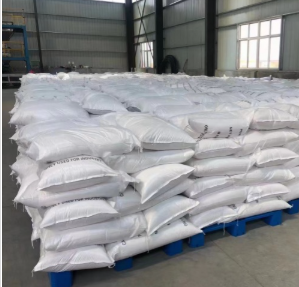
Boric acid #CAS:10043-35-3
Boric acid #CAS:10043-35-3
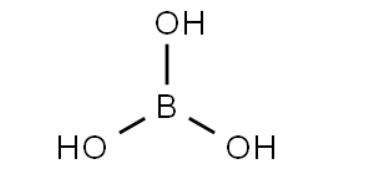
Boric acid is a monobasic acid that exhibits extremely weak acidity (Ka = 5.8 × 10⁻¹⁰), similar to silicic acid (K₁ = 2 × 10⁻¹⁰). Upon ionisation in water, it does not donate protons directly but instead forms a complex with hydroxide ions present in the solution:H₃BO₃ + 2H₂O → H₃O⁺ + B(OH)₄⁻This behaviour is related to the electron-deficient nature characteristic of boron compounds. In boric acid, the boron atom acts as an electron pair acceptor by bonding with a hydroxide ion, where the oxygen atom serves as the electron pair donor. Thus, boric acid is considered a typical Lewis acid.
When glycerol or mannitol [CH₂(OH)(CHOH)₄CH₂OH] is added to a boric acid solution, its acidity increases. This is because boric acid forms a coordination complex (anion) with glycerol, which facilitates the release of H⁺ ions, thereby enhancing ionisation.
In the crystal structure of boric acid, the fundamental unit is the planar triangular BO₃ group. Each boron atom undergoes sp² hybridisation, and each oxygen atom forms a covalent bond with a boron atom, while also interacting with two hydrogen atoms through covalent and hydrogen bonding. These interactions give rise to layered, sheet-like macromolecular structures. Upon heating, the weak hydrogen bonds are disrupted, leading to disintegration of the macromolecular sheets and an increase in solubility.
Applicaion of Boric acid
Boric acid can be used to study molecular biology, DNA and RNA purification, biological buffers and molecular biology reagents. Boric acid has been used to test the toxic effects of boron on growth and antioxidant system parameters of maize (Zea mays L.) roots. Boric acid has also been used to study the effect of time period after boric acid injection on (10)B absorption in different regions of adult male rat′s brain.
For weatherproofing wood and fireproofing fabrics; as a preservative; manufacture of cements, crockery, porcelain, enamels, glass, borates, leather, carpets, hats, soaps, artificial gems; in nickeling baths; cosmetics; printing and dyeing, painting; photography; for impregnating wicks; electric condensers; hardening steel. Also used as insecticide for cockroaches and black carpet beetles.
In the production of high-grade glass—such as optical glass, acid-resistant glass, and borosilicate glass—as well as glass fiber, boric acid improves heat resistance and transparency, enhances mechanical strength, and shortens melting times. In glass fiber manufacturing, for instance, it lowers the melting temperature, which facilitates the fiber-drawing process. In general, B₂O₃ helps reduce viscosity, control thermal expansion, prevent devitrification, improve chemical stability, and enhance resistance to both mechanical and thermal shock. In glass production, boric acid is often used in combination with sodium borates (such as borax pentahydrate or anhydrous borax) to adjust the sodium-to-boron ratio within the glass composition.
In the production of enamels and ceramics, boron oxide serves as an excellent flux and network former. It facilitates glass formation at lower temperatures, improves the compatibility between the body and the glaze, reduces viscosity and surface tension, increases the refractive index, and enhances mechanical strength, durability, and wear resistance; it is a key component of lead-free glazes. High-boron frits mature rapidly, quickly forming a smooth glazed surface that is conducive to coloring. When used in the production of glazes, it reduces thermal expansion and lowers the solidification temperature, thereby preventing cracking (crazing) and glaze peeling, while also improving the gloss and durability of the finished products.
When added to celluloid materials, borates alter the oxidation reaction and promote "carbonization," which imparts flame-retardant properties. Used either alone or in combination with borax, boric acid is highly effective in reducing the flammability of celluloid-based insulation, wooden items, and the cotton batting used in mattresses.
Boric acid is used as an additive and flux in the production of boron-alloyed steel, imparting high hardness and good rollability. It also prevents surface oxidation during metal welding, brazing, and soldering, and serves as a raw material for the production of ferroboron alloys.
Boric acid functions as an anti-rust agent, lubricant, and thermal-oxidative stabilizer. It is incorporated into lubricants, brake fluids, metalworking fluids, water treatment agents, and fuel additives.
Boric acid is a component in adhesives for corrugated cardboard and acts as a peptizing agent in the production of casein- and dextrin-based adhesives. Boric acid significantly improves wet-glue strength through the formation of cross-linking hydroxyl bonds.
It can be used for deliming the surface of bare hides, preventing the appearance of lime spots on the leather after the re-tanning process.
It can be used in the production of boric acid ointment, disinfectants, astringents, and preservatives. National Formulary (NF) grade boric acid is used in cosmetics, hygiene products, and pharmaceuticals. It also serves as a cross-linking agent for emulsified paraffin and can function as a bacteriostatic agent.
| Boric acid Chemical Properties |
| Melting point | 170.9 °C (339.6 °F; 444.0 K) |
| Boiling point | 300 °C (572 °F; 573 K) |
| density | 1.435 g/cm3 |
| bulk density | 400-600kg/m3 |
| vapor pressure | 2.6 mm Hg ( 20 °C) |
| refractive index | n 20/D 1.330-1.340 |
| Fp | Nonflammable |
| storage temp. | Store at +5°C to +30°C. |
| solubility | H2O: soluble |
| pka | 8.91±0.43(Predicted) |
| form | crystalline solid |
| color | White |
| Specific Gravity | 1.435 |
| PH | 3.6-4.4 (25℃, saturated solution in H2O) |
| Odor | Odorless |
| PH Range | 3.8 - 4.8 |
| Water Solubility | 49.5 g/L (20 ºC) |
| Specific Heat Capacity | Cp(crystal): 1.39 J/(g·K), at 25℃ |
| Sensitive | Hygroscopic |
| λmax | λ: 260 nm Amax: 0.05 λ: 280 nm Amax: 0.05 |
| Merck | 14,1336 |
| BRN | 1697939 |
| Henry's Law Constant | 3.8×10⁶ mol/(m3Pa) at 25℃, HSDB (2015) |
| Exposure limits | ACGIH: TWA 2 mg/m3; STEL 6 mg/m3 |
| Cosmetics Ingredients Functions | BUFFERING DENATURANT ANTIMICROBIAL |
| Cosmetic Ingredient Review (CIR) | Boric acid (10043-35-3) |
| InChI | 1S/BH3O3/c2-1(3)4/h2-4H |
| InChIKey | KGBXLFKZBHKPEV-UHFFFAOYSA-N |
| SMILES | OB(O)O |
| LogP | -1.09 at 22℃ |
| CAS DataBase Reference | 10043-35-3(CAS DataBase Reference) |
| NIST Chemistry Reference | B(OH)3(10043-35-3) |
| EPA Substance Registry System | Orthoboric acid (10043-35-3) |
| Absorption | ≤0.05 at 260 in H2O at 1M ≤0.05 at 280 in H2O at 1M |
| Safety Information |
| Hazard Codes | Xi,T,Xn |
| Risk Statements | 36/37/38-60-63-62-61 |
| Safety Statements | 26-36-53-45-37/39-36/37/39-22-24/25-23 |
| WGK Germany | 2 |
| RTECS | ED4550000 |
| F | 3 |
| TSCA | TSCA listed |
| HS Code | 28100090 |
| Storage Class | 6.1C - Combustible acute toxic Cat.3 toxic compounds or compounds which causing chronic effects |
| Hazard Classifications | Repr. 1B |
| Hazardous Substances Data | 10043-35-3(Hazardous Substances Data) |
| Toxicity | LD50 orally in rats: 5.14 g/kg (Smyth). |
Fact Factory and Equipment Show