Gluconic acid #CAS526-95-4
Gluconic acid #CAS526-95-4
Gluconic acid (also known as gluconate) is an organic compound occurring widely in nature arising from the glucose oxidation. It is naturally found in fruit, honey and wine. It can also be used as a food additive to regulate acidity and a cleaning agent in alkaline solution. Its calcium salt, calcium gluconate can be used to treat burns from hydrofluoric acid and avoid necrosis of deep tissues as well as treating the verapamil poisoning and hypocalcemia in hospitalized patient. Some salts of gluconate can also be used to treat malaria (quinidine gluconate) and anemia (ferrous gluconate). In microbiology, gluconate is a common carbon source that can be supplemented to the medium for cell growth.
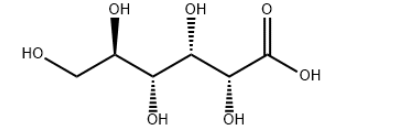
Gluconic acid is an organic compound with molecular formula C6H12O7 and condensed structural formula HOCH2(CHOH)4COOH. It is one of the 16 stereoisomers of 2,3,4,5,6-penta hydroxy hexanoic acid.
In aqueous solution at neutral pH, gluconic acid forms the gluconate ion. The salts of gluconic acid are known as "gluconates". Gluconic acid, gluconate salts, and gluconate esters occur widely in nature because such species arise from the oxidation of glucose. Some drugs are injected in the form of gluconates.
Applicaion of Gluconic acid
Gluconic Acid is an acidulant that is a mild organic acid which is the hydrolyzed form of glucono-delta-lactone. it is prepared by the fermentation of dextrose, whereby the physiological d-form is produced. it is soluble in water with a solubility of 100 g/100 ml at 20°c. it has a mild taste and at 1% has a ph of 2.8. it functions as an antioxidant and enhances the function of other antioxidants. in beverages, syrups, and wine, it can eliminate calcium turbidities. it is used as a leavening component in cake mixes, and as an acid component in dry-mix desserts and dry beverage mixes.
Gluconic acid occurs naturally in fruit, honey, and wine. As a food additive it is an acidity regulator. It is also used in cleaning products.
Currently, gluconic acid is commercially produced by submerged fed-batch cultivations of Aspergillus niger using glucose as substrate. A. niger produces citric acid and gluconic acid growing on glucose. The product concentration and yields of the product depend on the fermentation conditions. For optimal gluconic acid production, high glucose concentrations (110–250 g.L-1), low concentrations of nitrogen and phosphorus in the medium, a limitation of metal ion concentrations, a pH value in the range of 4.5–6.5, and high aeration rates for the oxygen supply are needed.
Much research has been carried out to find new ways for cheaper production. Different microorganisms have been studied (e.g. G. oxydans, Z. mobilis, A. methanolicous, and P. fluorescence. Moreover, new microbial strains have been developed by mutagenesis or genetic engineering. Additionally, the fermentation process and recovery have been optimized. New inexpensive substrates (e.g. cornstarch, grape or banana must, figs, and cheese whey) have been tested.
One example of a new and efficient production process of gluconic acid is the cultivation of Aureobasidium pullulans growing on glucose. Using a continuous process with biomass retention by crossover filtration, a product concentration of 375 g.L-1, a yield of 0.83 g of gluconic acid per gram of glucose, and a productivity of 17 g.L-1.h-1 could be achieved at a residence time of 22 h. In this process, 100 % of the glucose is converted. This process might be interesting for industrial applications. In continuous gluconic acid production with immobilized mycelia of A. niger, product concentrations of 120–140 g.L-1 have been achieved.
| Gluconic acid Chemical Properties |
| Melting point | 15 °C |
| Boiling point | 102 °C |
| alpha | D20 -6.7° (c = 1) |
| density | 1.23 |
| refractive index | 1.4161 |
| storage temp. | Store below +30°C. |
| solubility | DMSO (Slightly), Methanol (Slightly), Water |
| form | Crystalline Powder or Crystals |
| pka | pK (25°) 3.60 |
| color | White to light yellow |
| Specific Gravity | 1.234 |
| PH | 2.2 (20°C, 500g/L in H2O) |
| Odor | commercial 50 aq. soln. lt. amber, faint odor of vinegar |
| Optical Rotation | [α]/D +9.0 to 15.5° |
| Water Solubility | Soluble in water. |
| Merck | 14,4456 |
| BRN | 1726055 |
| Cosmetics Ingredients Functions | CHELATING PERFUMING |
| Cosmetic Ingredient Review (CIR) | Gluconic acid (526-95-4) |
| InChI | 1S/C6H12O7/c7-1-2(8)3(9)4(10)5(11)6(12)13/h2-5,7-11H,1H2,(H,12,13)/t2-,3-,4+,5-/m1/s1 |
| InChIKey | RGHNJXZEOKUKBD-SQOUGZDYSA-N |
| SMILES | OC[C@@H](O)[C@@H](O)[C@H](O)[C@@H](O)C(O)=O |
| LogP | -2.116 (est) |
| CAS DataBase Reference | 526-95-4(CAS DataBase Reference) |
| NIST Chemistry Reference | Gluconic acid(526-95-4) |
| EPA Substance Registry System | D-Gluconic acid (526-95-4) |
| Safety Information |
| Hazard Codes | Xi,C |
| Risk Statements | 36/37/38-34 |
| Safety Statements | 37/39-26-45-36/37/39 |
| RIDADR | 3265 |
| WGK Germany | - |
| RTECS | LZ5057100 |
| TSCA | TSCA listed |
| HazardClass | 8 |
| PackingGroup | III |
| HS Code | 29181600 |
| Storage Class | 10 - Combustible liquids |
| Hazardous Substances Data | 526-95-4(Hazardous Substances Data) |
Fact Factory and Equipment Show