D(-)-Tartaric acid #CAS526-83-0
CAS Number:526-83-0
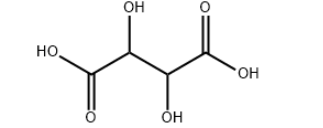
Chemical Formula:C4H6O6
Synonyms:
D(-)-Tartaric acid
D(-)-Tartaric acid, 98%+
high quality D(-)-Tartaric acid
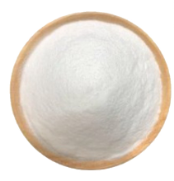
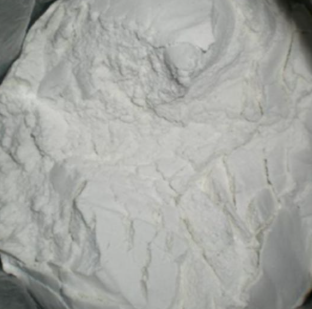
Appearance:White to Off-White Solid
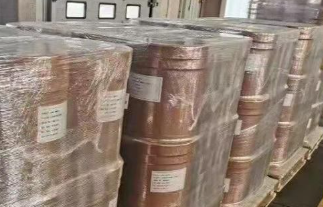
MOQ (Minimum Order Quantity): 1 FCL (Full Container Load)
D(-)-Tartaric acid #CAS526-83-0
Tartaric acid is a white crystalline diprotic aldaric acid. It occurs naturally in many plants, particularly grapes, bananas, and tamarinds, is commonly combined with baking soda to function as a leavening agent in recipes, and is one of the main acids found in wine. It is added to other foods to give a sour taste, and is used as an antioxidant. Salts of tartaric acid are known as tartrates. It is a dihydroxyl derivative of succinic acid.
Tartaric acid was first isolated from potassium tartrate, known to the ancients as tartar, circa 800 AD, by the alchemist Jabir ibn Hayyan The modern process was developed in 1769 by the Swedish chemist Carl Wilhelm Scheele.
Tartaric acid played an important role in the discovery of chemical chirality. This property of tartaric acid was first observed in 1832 by Jean Baptiste Biot, who observed its ability to rotate polarized light. Louis Pasteur continued this research in 1847 by investigating the shapes of ammonium sodium tartrate crystals, which he found to be chiral. By manually sorting the differently shaped crystals under magnification, Pasteur was the first to produce a pure sample of levotartaric acid.
Application of D(-)-Tartaric acid
Since the tartaric acid molecule contains two identical asymmetric carbon atoms, it has three rotary isomers, dextro-tartaric acid [L(+)-tartaric acid], levo-tartaric acid [D(-)-tartaric acid], and endo-racemic tartaric acid (Meso). Equal amounts of levotartaric acid were mixed with dextro-tartaric acid to obtain racemic tartaric acid or DL-tartaric acid. L-tartaric acid and dextro-tartaric acid are enantiomers. All naturally occurring tartaric acid is dextrorotatory. It is a colorless transparent crystal or a white fine to granular crystalline powder. The crystalline product contains 1 molecule of water of crystallization, odorless, stable in air, sour taste, acidity threshold value 0.0025%, acidity intensity of about 1.2 ~ 1.3 times that of citric acid, slightly astringent taste, burning with the odor of roasted sugar, with metal ion chelating effect. 1g dissolved in 0.8mL water (25℃), 0.5mL boiling water, 3mL ethanol. 0.3% aqueous solution of pH 2.4.
Pharmaceutic aid (buffering agent).
| D(-)-Tartaric acid Chemical Properties |
| Melting point | 159-171°C |
| Boiling point | 399.3±42.0 °C(Predicted) |
| density | 1.886±0.06 g/cm3(Predicted) |
| storage temp. | Sealed in dry,Room Temperature |
| solubility | DMSO (Slightly, Heated), Methanol (Slightly), Water (Sparingly, Sonicated) |
| pka | 3.07±0.34(Predicted) |
| form | Solid |
| color | White to Off-White |
| Odor | at 100.00 %. odorless |
| Odor Type | odorless |
| InChI | InChI=1S/C4H6O6/c5-1(3(7)8)2(6)4(9)10/h1-2,5-6H,(H,7,8)(H,9,10) |
| InChIKey | FEWJPZIEWOKRBE-UHFFFAOYSA-N |
| SMILES | C(O)(=O)C(O)C(O)C(O)=O |
| LogP | -1.081 (est) |
| EPA Substance Registry System | 2,3-Dihydroxysuccinic acid (526-83-0) |
| Safety Information |
| RIDADR | UN2811 |
| HazardClass | 6.1 |
| HS Code | 29181200 |
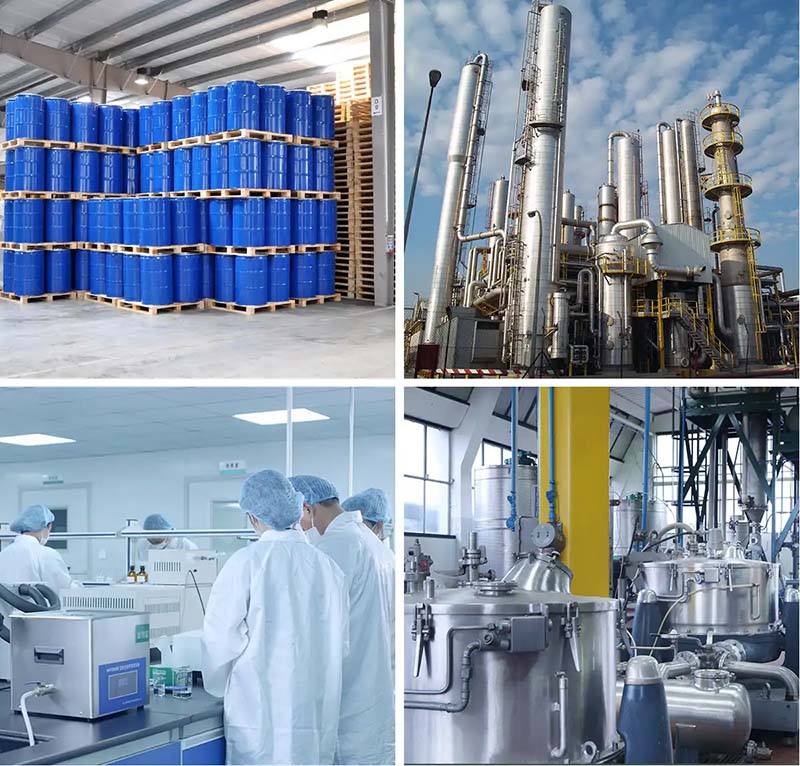
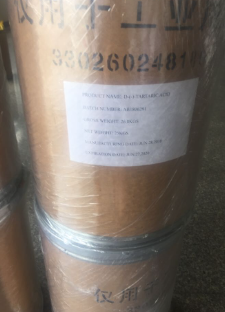
Fact Factory and Equipment Show