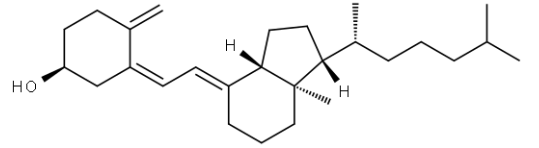

Vitamin D3 #CAS67-97-0
CAS Number:67-97-0
Chemical Formula:C27H44O
Synonyms:
Vitamin D3-d3 Cholecalciferol (6,19,19-d3)
Vitamin D3-d6
VITAMIN D3 99+%
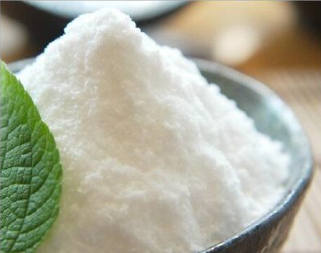
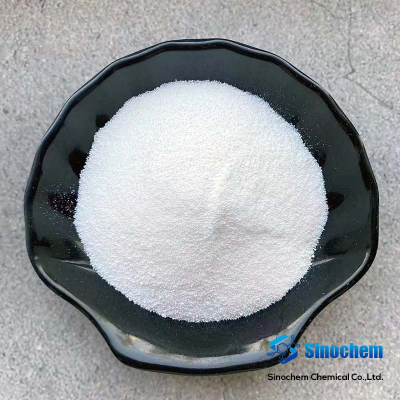
Appearance:White or colorless crystalline solid. Odorless
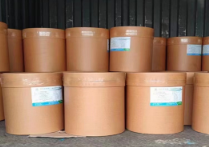
MOQ (Minimum Order Quantity): 1 FCL (Full Container Load)
Vitamin D3 #CAS67-97-0
White columnar crystals or crystalline powder, odorless and tasteless. Melting point 84~88℃, specific rotation αD20 =+105°~+112°. Easily soluble in chloroform, soluble in alcohol, ether, cyclohexane and acetone, slightly soluble in vegetable oil, insoluble in water. Good heat resistance, but unstable for light. Easily oxidized in air. Rats by oral LD1042mg/kg.
Vitamin D2 and D3 are all colorless crystals. The melting point of D2 and D3 respectively are 115~118℃ and 84~85℃. They are insoluble in water, and soluble in ethanol and other organic solvents. Their solubility in vegetable oil are small. Crystalline vitamin D should be stored in dark to light and oxygen at low temperature. Vitamin D3 is more stable than D2. It is not easy to be oxidized. Vitamin D has heat stability in the near neutral solution. It will be rapidly destroyed in the acidic solution, and the rate of destruction depends on strength and temperature of the acid. However, it is stable in alkaline solution. It can tolerate alkali treatment even under high temperature conditions.
Application of Vitamin D3
1. Vitamin D3 can maintain normal metabolism of calcium and phosphorus, promote the body's absorption of calcium and phosphorus. When it is lacked, children are easy to get rickets. Regulations in China provides it can be used to strengthening margarine. The dosage is 125~156μg/kg. The dosage in fortified dairy products is 63~125μg/kg. The dosage in strengthening infant food is 50~100μg/kg. And the dosage in strengthening milk and milk drink is 10~40μg/kg. The largest dosage in the strengthening solid drinks and ice cream is 10~20μg/kg.2. Vitamin D3 can maintain normal metabolism of calcium and phosphorus and promote the body's absorption of calcium and phosphorus. The utilization of 1. vitamin D2 and D3 for pigs are the same, but the utilization of vitamin D2 for poultry is only 1/40-1/30 of vitamin D3. When lack of Vitamin D3, eggshell will become thin, the rate of laying will decrease, and rickets will appear. The amount can be 1000-1500IU/kg.
3. Vitamin D is a fat-soluble vitamin. There are a dozen compounds that are known to have the effect of vitamin D. Vitamin D2 and vitamin D3 have the important practical significance in no lines steroid derivative. D3 is given priority to with in the world, "International Standards" of vitamin D is pure crystalline D3. The main function of vitamin D are metabolism of calcium, phosphorus. It is difficult to promote the absorption of calcium and phosphorus and the calcification of bone. When the body is lack of vitamin D, the ability to absorb calcium and phosphorus will decrease, and the content of calcium and phosphorus in the blood will reduce. Then calcium and phosphorus cannot be deposited in bone tissue, even bone salt will dissolve and hinder the bone calcification. Children lack of vitamin D will get rickets. Adult lack of vitamin D will get osteomalacia. Japanese like to produce and use D2. In a variety of demand, the amount of pharmaceutical is 30%, feed additives is 65%, and food additives is 5%. According to the "food fortifier use of health standards (1993)" issued by Ministry of Health, D2 and D3, as nutritional supplements, can be used for liquid milk, margarine, dairy products and baby food.
4. Vitamin medicines. It mainly can promote intestinal absorption and deposition of calcium and phosphorus for the treatment of rickets and osteomalacia.
5. It is mainly used in food, health products and other related products.
The vitamin that mediates intestinal calcium absorbtion, bone calcium metabolism and probably, muscle activity. Occurs in and is isolated from fish liver oils. Vitamin D acts through a receptor that i s a member of the ligand-dependent transcription factor superfamily. Modulates the proliferation and differentiation of both normal and cancer cells. Has antiproliferative and antimetastatic effects o n breast, colon, and prostate cancer cells. Activated vitamin D receptors in intestine and bone maintain calcium absorbance and homeostasis| Vitamin D3 Chemical Properties |
| Melting point | 83-86 °C(lit.) |
| alpha | 105 º (c=0.8, EtOH 25 ºC) |
| Boiling point | 451.27°C (rough estimate) |
| density | 0.9717 (rough estimate) |
| vapor pressure | 2.0 x l0-6 Pa (20 °C, est.) |
| refractive index | 1.5100 (estimate) |
| Fp | 14 °C |
| storage temp. | -20°C |
| solubility | Practically insoluble in water, freely soluble in ethanol (96 per cent), soluble in trimethylpentane and in fatty oils. It is sensitive to air, heat and light. Solutions in solvents without an antioxidant are unstable and are to be used immediately. A reversible isomerisation to pre-cholecalciferol takes place in solution, depending on temperature and time. The activity is due to both compounds. |
| form | powder |
| pka | 14.74±0.20(Predicted) |
| color | White |
| Odor | odorless |
| biological source | synthetic (organic) |
| Water Solubility | <0.1 g/L (20 ºC) |
| Sensitive | Air & Light Sensitive |
| Merck | 14,10019 |
| BRN | 2339331 |
| Henry's Law Constant | 4.3×10⁻² mol/(m3Pa) at 25℃, HSDB (2015) |
| Stability: | Light Sensitive, Temperature Sensitive |
| Major Application | food and beverages |
| Cosmetics Ingredients Functions | ORAL CARE SKIN CONDITIONING - MISCELLANEOUS |
| InChIKey | QYSXJUFSXHHAJI-YRZJJWOYSA-N |
| SMILES | CC(C)CCC[C@@H](C)[C@@]1([H])CC[C@@]([C@]1(C)CCC/2)([H])C2=C\C=C(C[C@@H](O)CC3)/C3=C |
| LogP | 9.085 (est) |
| CAS DataBase Reference | 67-97-0(CAS DataBase Reference) |
| NIST Chemistry Reference | Cholecalciferol(67-97-0) |
| EPA Substance Registry System | Cholecalciferol (67-97-0) |
| Safety Information |
| Hazard Codes | Xn,T |
| Risk Statements | 26-24/25 -48/25 |
| Safety Statements | 28-45-36/37 |
| WGK Germany | 2 |
| RTECS | VS2900000 |
| F | 8-10-23 |
| TSCA | TSCA listed |
| HS Code | 29362990 |
| Storage Class | 6.1A - Combustible acute toxic Cat. 1 and 2 very toxic hazardous materials |
| Hazard Classifications | Acute Tox. 2 Dermal Acute Tox. 2 Inhalation Acute Tox. 2 Oral STOT RE 1 Oral |
| Hazardous Substances Data | 67-97-0(Hazardous Substances Data) |
| Toxicity | LD50 oral in rat: 42mg/kg |
Fact Factory and Equipment Show